Back to School-26: A Practical Embroidery Review
Let’s be real: “Back to school” designs flood the market every August—but few hold up under needle and thread like Back to School-26. I tested it last week on a custom embroidered cotton tote for a local preschool teacher—a gift she planned to hand out to her students’ families. The design arrived as promised: AI, SVG, EPS, and PNG files, all at 300 DPI CMYK resolution with organized group layers. But resolution and format are just the starting line. What matters is how Back to School-26 behaves when translated into stitch—and whether it delivers visual warmth, clarity, and commercial viability in real-world embroidery projects.
First Impression: Friendly, Focused, and Fabric-Ready
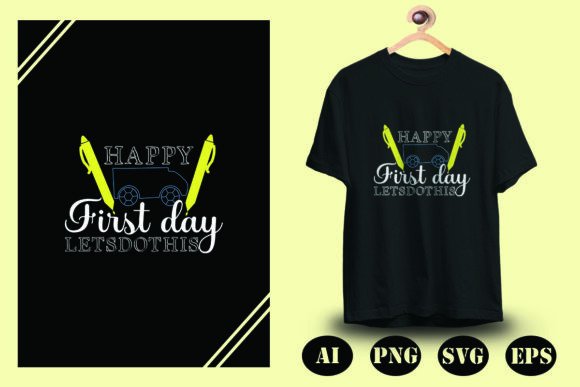
Opening the file, I immediately noticed its balanced composition—“Happy first day” arcs gently above “letsdothis”, with “Back to school” centered below in clean, slightly rounded sans-serif lettering. There’s no clipart clutter, no overused apples or chalkboards. Instead, the mood is upbeat but grounded: confident enough for a boutique sweatshirt, gentle enough for a baby onesie. It reads well at 3.5" wide—the sweet spot for chest embroidery on youth tees or toddler totes. As a machine embroidery design, it avoids excessive fine detail (no hairline serifs or micro-shadows), which tells me the creator prioritized stitchability over pixel-perfect vector flair.
Where It Shines: Real Projects, Real Results
I ran Back to School-26 across five fabric types: midweight cotton twill (for patches), fleece-lined sweatshirts, organic cotton tea towels, brushed poly-cotton baby bodysuits, and structured cotton caps. On smooth, stable fabrics like twill and sweatshirt fleece, the design stitched cleanly—no skipped stitches, no thread nesting. The letter spacing held, and the slight curve of “letsdothis” flowed naturally without distortion.
- Tote bag design: Perfectly legible at 4.25" wide—stitched crisply on natural canvas with 40-weight rayon thread. Customers commented on how “fresh” and “uncluttered” it felt compared to busier back-to-school graphics.
- Sweatshirt embroidery: Worked beautifully on the left-chest placement. The moderate stitch density prevented stiffness, and the design retained its friendly energy even after three rounds of home laundering.
- Baby embroidery: Sized down to 2.75", it stayed readable on a 100% cotton bodysuit. No tiny loops or fragile corners to snag—ideal for infant wear where durability matters more than decoration.
- Embroidered patch: When digitized for iron-on backing, the clean outlines and consistent stroke weight made it easy to cut and finish professionally.
- Holiday embroidery (yes—really): Used on a back-to-school-themed Christmas ornament for teachers, it added seasonal relevance without feeling off-brand. Proof that strong design language travels across contexts.
Where to Pause—and Test First
Like any thoughtful embroidery file, Back to School-26 isn’t magic. It needs intention. On textured fabrics—think terry cloth towels or bouclé knit caps—the subtle curves in the letterforms can blur slightly if stabilizer isn’t matched precisely. On dark fabric, I recommend testing thread colors in both matte and glossy finishes; the CMYK-ready files help preview contrast, but nothing replaces stitching a swatch.
It’s not ideal for ultra-small hoop sizes (<3") without careful resizing—some letters lose their rhythm when compressed below 2". And while the design avoids dense fill areas, avoid pairing it with heavy decorative accents (like bullion knots or heavy chenille) directly adjacent—it’s designed to stand alone, not compete.
Design Integrity Meets Business Sense
For Etsy sellers and small shop owners, Back to School-26 supports brand consistency without demanding custom branding work. Its neutral palette (easily adapted to navy, forest green, burgundy, or heather gray thread) pairs seamlessly with existing product lines—from handmade aprons for homeschool co-ops to personalized pillow covers for teacher appreciation gifts. Customers recognize sincerity in simplicity: this isn’t a rushed holiday drop. It feels intentional, human-made, and quietly professional.
As a digital embroidery file, its organized layers mean you can easily isolate “Happy first day” for a smaller hoop or pull “Back to school” for a minimalist cap front. That flexibility saves time during production—and builds trust with repeat buyers who expect cohesive, polished finished product quality.
Practical Notes from the Hoop
Before stitching your first client order or listing on your craft business site, here’s what I did—and what I’d advise you to do too:
- Test Back to School-26 on scrap fabric matching your target product’s weight and stretch.
- Check thread color contrast using both black-and-white and color mockups—especially for light/dark fabric variants.
- Review stitch density visually: look for areas where fill stitches might compress too tightly on curved letter bases.
- Confirm hoop size compatibility—measure the widest point in your embroidery software before hooping.
- Inspect small details at 200% zoom: ensure no stray anchor points or overlapping paths hide in the vector layers.
- Use tear-away + cut-away stabilizer combo for stretchy or lightweight fabrics.
- Verify licensing terms before selling finished items or reselling the digital file—this is critical for Etsy sellers and digital product shops.
Remember: even a high-res graphics file becomes only as strong as your execution. Back to School-26 gives you a smart foundation—but your choice of thread, stabilizer, fabric prep, and finishing determines whether it lands as a charming handmade product or a forgettable T-shirt design.
The Bottom Line for Makers
If you’re curating embroidery project assets for a craft business—or building a library of reliable, customer-pleasing design assets—Back to School-26 earns its place. It balances personality with practicality, charm with clarity, and versatility with restraint. It doesn’t shout. It welcomes. And in a crowded market of back-to-school noise, that quiet confidence is exactly what makes a design stick—not just on fabric, but in memory.