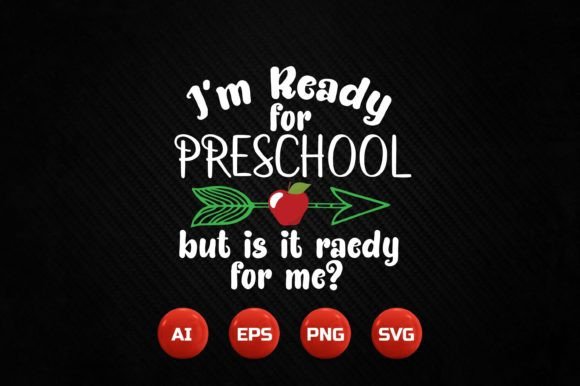
Back to School T-shirt Design 68
As someone who’s digitized, stitched, and sold hundreds of embroidery designs—especially for preschool and early childhood markets—I opened Back to School T-shirt Design 68 expecting charm, clarity, and craft-ready practicality. What I found was a design that lands right where it should: warm, legible, and quietly confident—not shouting, but smiling with intention. The phrase “I’m Ready for PRESCHOOL but is it ready for me” carries gentle humor and childlike agency, which makes it stand out in a sea of generic “First Day” graphics.
A Real-World Test: Embroidering This on a Linen-Cotton Tote Bag
Last week, I used Back to School T-shirt Design 68 to embroider a set of personalized tote bags for a local preschool co-op’s welcome kits. We chose natural linen-cotton blend fabric—textured, breathable, and popular with eco-conscious parents—but also tricky for crisp lettering. The design held up beautifully. Its clean vector foundation (AI, EPS, SVG included) meant no pixelation when scaling to 4.5 inches wide—the sweet spot for tote front visibility without overwhelming the fabric. The uppercase “PRESCHOOL” anchors the layout, while the playful question mark at the end invites interaction. Parents kept commenting on how “real” it felt—not cutesy or forced, just authentically kid-centered.
Where This Design Truly Shines
- Custom apparel: Works especially well on crewneck sweatshirts and relaxed-fit tees where readability matters more than fine detail.
- Baby and toddler items: I stitched a scaled-down version (3.2”) on a soft cotton onesie—no puckering, no thread breakage. The open letterforms and generous spacing between words prevented fill-stitch crowding.
- Embroidered patches: Because it’s 100% vector and print-ready, converting Back to School T-shirt Design 68 into an iron-on or sew-on patch was seamless. The clean edges translated cleanly to satin-stitched borders.
- Small shop merchandise: As a boutique owner or Etsy seller, this design supports brand consistency—it’s friendly but not childish, nostalgic but not dated. It fits equally well on tea towels, pillow covers, and aprons for teacher gift bundles.
- Commercial embroidery projects: Its balanced stitch density avoids excessive thread build-up, making it reliable across multiple garments in a batch order—even on mid-weight fleece or French terry.
Where to Pause—and Plan Ahead
This isn’t a one-size-fits-all embroidery file. Like any thoughtful design, Back to School T-shirt Design 68 asks for context-aware decisions:
- Small hoop sizes: Avoid hooping below 3 inches wide—the lowercase “i” and question mark need breathing room. At under 2.7”, fine details risk blending or skipping.
- Textured or stretchy fabrics: On jersey or ribbed knits, use medium-weight cutaway stabilizer underneath and a light tear-away on top. The design’s moderate fill-stitch coverage helps, but don’t skip stabilization—especially around the curved baseline of “ready”.
- Dark or layered garments: While the vector files let you easily adjust thread colors, test contrast first. White or pale yellow thread on navy sweatshirts reads clearly; neon pink on black can vanish unless you add an underlay stitch (check your digitizer notes—or add one manually).
- Curved surfaces like caps: The horizontal layout isn’t ideal for front-panel cap embroidery without repositioning. Consider rotating or simplifying for that application—or save it for back-strap or side-embroidery placements.
- Frequent-wash items: For baby bibs or kitchen towels, reinforce high-friction zones (like the bottom curve of “me”) with a slight increase in underlay—not enough to stiffen, just enough to lock down edge definition over time.
Design Judgment: How It Shapes Perception
What makes Back to School T-shirt Design 68 more than decoration? It builds trust. When a parent sees this stitched neatly on a handmade item, they read care, attention, and emotional intelligence—not just technical skill. That translates directly to perceived value: customers pay more for pieces that feel intentional, not mass-produced. For Etsy sellers, that means better conversion on listings with lifestyle mockups showing real use—not just flat PNGs. For craft fair vendors, it means repeat buyers who remember your booth because your designs *feel* human.
It also holds up in black-and-white mockups—a quiet but critical test. Many cheerful designs lose personality in grayscale, but this one keeps its rhythm and balance. That’s proof of strong composition, not just color dependency. And because it’s offered as AI, EPS, PNG, and SVG files, you’re not locked into one workflow: vector for resizing, PNG for quick digital previews, SVG for web-based mockup tools.
Practical Notes Every Embroidery Designer Should Run Through
- Test Back to School T-shirt Design 68 on scrap fabric matching your final product’s weight and stretch.
- Check thread color contrast against both light and dark backgrounds—don’t assume your default palette works universally.
- Review stitch density visually: look for dense clusters near curves or joins that could cause stiffness or distortion.
- Confirm your hoop size accommodates the full width comfortably—no last-minute cropping.
- Inspect small details like the dot over the “i” and the tail of the question mark—they’re subtle, but their clarity signals craftsmanship.
- Use proper stabilizer for your fabric type—especially important if selling finished products commercially.
- Verify licensing before listing embroidered items for resale or offering the design as part of a digital bundle. The product description says it’s “100 vector” and “print ready,” but commercial rights aren’t specified—always double-check.
In short: Back to School T-shirt Design 68 earns its place in your working library—not as a novelty, but as a dependable, emotionally resonant tool. It’s the kind of machine embroidery design that makes clients pause, smile, and say, “Yes—that’s exactly how I want my child’s first school year to feel.” And for designers, sellers, and makers building something real? That’s not just good design. It’s good business.